Great Follow-Up Advice Landed in My Inbox. One Line of It Was Wrong.
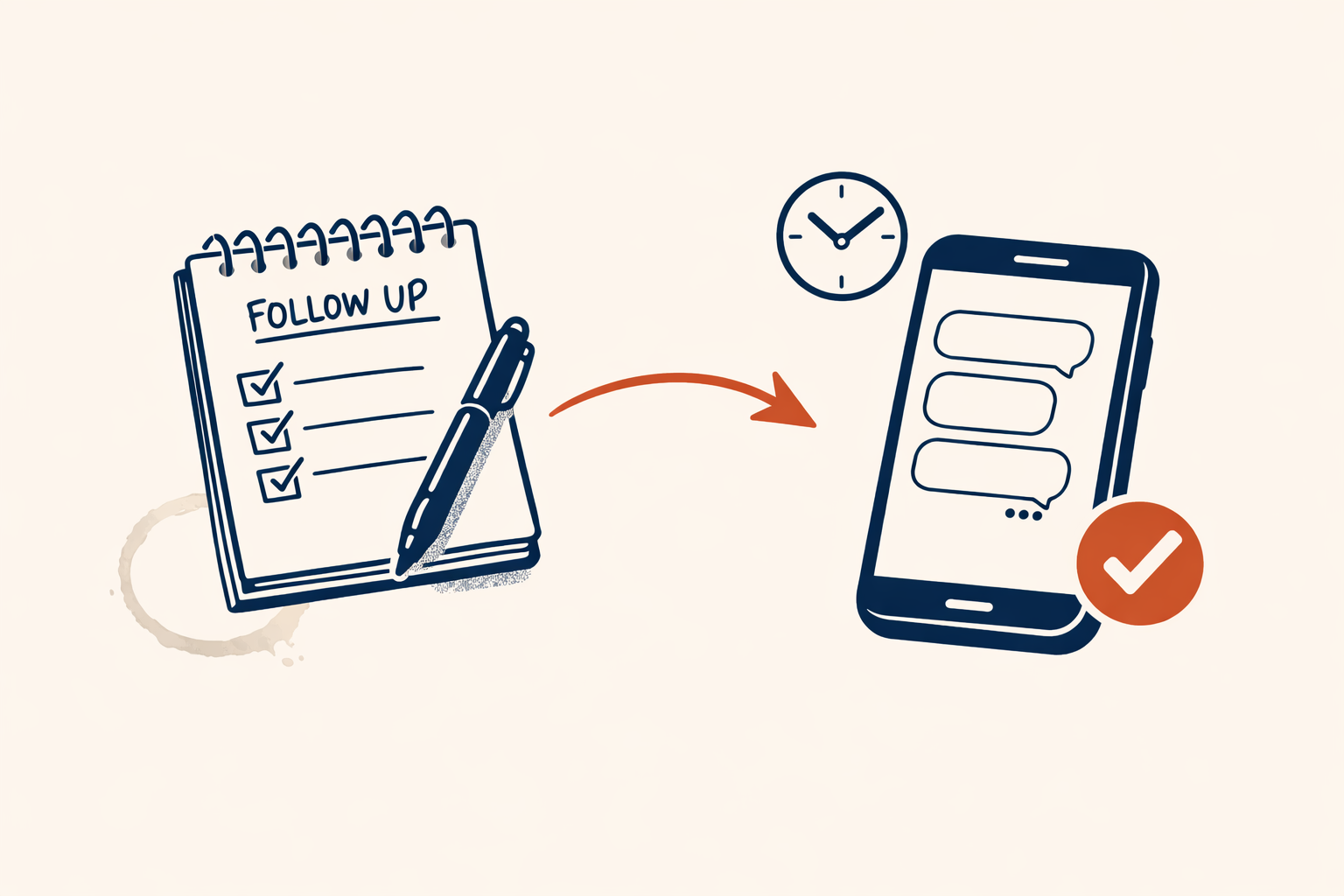
A home-improvement magazine's newsletter landed in my inbox this week with a subject line built to sting: "You're losing jobs you already paid for." I expected fluff and got four pieces of follow-up advice I agree with almost completely. Call back within the hour. Follow up at least three times. Write down every lead. Return your missed calls. All four are right. Then came the line that made me open my laptop: the fix, it said, doesn't require software, a sales team, or a big time commitment.
That line is technically true. It is also, in my experience as an owner who tried to do it by hand, practically wrong. This post is about the gap between those two things.
The four habits, and why they hold up
The newsletter's four habits match some of the most-cited sales research anywhere: respond within the hour, make repeated follow-up attempts, record every lead, and return every missed call. None of this is opinion. The numbers behind each habit are strong enough that I would put them on the shop wall.
Start with speed. Harvard Business Review audited 2,241 US companies by sending each one a web lead and timing the reply. 23% never responded at all. Among the companies that did respond, the average time was 42 hours. Two full days, for a lead that started shopping the moment they hit submit. The same research program found that replying within 5 minutes instead of 30 made a business 21 times more likely to qualify the lead. I wrote a whole post on that number: the 5-minute rule.
Persistence has its own data. Velocify's contact-strategy study, built on 3.5 million leads across more than 400 companies, found that 93% of leads that eventually convert are reached by the sixth call attempt. Most contractors make one call, hit voicemail, and mentally file the lead as dead. The data says the lead was probably just busy. So was the contractor. That is the whole problem, and we will get to it.
So no argument from me on the habits. The magazine did its readers a favor by printing them.
Can you really run this without software?
Technically, yes. A notebook, a phone, and discipline can execute all four habits, and the newsletter is honest about that. Practically, for an owner who is also the estimator, the crew lead, and the bookkeeper, the manual version does not survive a busy month. The constraint was never knowledge. It is what wins the priority fight at 2pm.
Here is the flaw in the "no software needed" framing. It assumes the reason follow-up fails is that owners don't know what to do. But most owners I talk shop with already know they should call leads back fast. The advice fails at execution, because follow-up is the classic important-but-never-urgent task. The paying job in front of you has a deadline today. The follow-up call has a deadline of "soon." Soon loses. Every time, soon loses.
A checklist doesn't change that math. It just documents what you were supposed to do while you were on a roof.
Where manual tracking broke for me
I can speak to the manual version because I ran it. Alongside Front Door Digital I run a permanent-lighting company, and in the early days my lead tracking was exactly what the newsletter prescribes: write it down, call back, follow up, check the missed-call log. I knew the research. I had read the 5-minute stat before I ever missed a lead.
Things still fell through the cracks. Not because the system was bad on paper, but because the system depended on me being interruptible at the exact moment a lead needed a touch, and installation work is the opposite of interruptible. The worst one cost me real money: a $3,000 job that went to a competitor because I missed the call and didn't get back fast enough. I wrote that story up in its own post, and the short version is that the homeowner did nothing wrong. They called, I didn't answer, they called the next company on the list. Rational behavior on their end. An unforced error on mine.
That is what "you don't need software" glosses over. The habit isn't hard to understand. It is hard to perform while doing the work the leads are calling about.
The arithmetic that kills the notebook
Run the numbers on what the four habits actually ask of you. Five new leads in a week, with six touches each to hit the threshold where 93% of conversions happen, is 30 scheduled actions. Each one has a time window, and each window opens while you are mid-job, mid-drive, or mid-dinner.
And those 30 actions are just the outbound side. Inbound is leaking at the same time: Invoca's home-services research puts the average miss rate around 27% of incoming calls, at roughly $1,200 in lost work per missed call. So the manual plan asks you to make 30 well-timed touches per week while also answering a phone you statistically miss one time in four.
The notebook has a quieter failure mode too. "Write down every lead" is itself a task that needs doing in the moment, with gloves on, on a ladder, between change orders. The recording habit fails first, and once a lead was never written down, every downstream habit fails silently with it. You don't feel it happen. You just have a slow month and blame the ads.
This is why I don't think willpower is the answer. I think the trigger has to move somewhere willpower isn't involved.
What each habit looks like automated
Each habit has a version that runs without your memory in the loop. The habit stays the same. The trigger moves from your head to a system that doesn't get busy.
- Call back within the hour becomes missed-call text-back. The moment a call rings out, the caller gets a text from your business number: sorry we missed you, we're on a job, what do you need? The lead is held within seconds, not within whenever you next check your phone. You still make the human call back. The text just stops the homeowner from dialing the next contractor while they wait.
- Follow up at least three times becomes a scheduled sequence. Text on day one, email on day two, a call reminder on day four. It fires whether you remembered or not, and it stops the moment the lead replies.
- Write down every lead becomes automatic capture. Every call, text, and form fill lands in one list with a timestamp and a status. Nothing depends on a pen, and nothing gets lost between the truck and the desk.
- Return missed calls becomes a morning list. Every missed call from yesterday, in one place, with one tap to dial. No scrolling the recents log at 9pm trying to remember which numbers were customers.
There is also an upgraded version of that first fix, and it is worth knowing about even if you start cheap. Missed-call text-back catches the lead. An AI receptionist answers the call in the first place: it picks up when you can't, asks what the caller needs, answers the common questions, and books the appointment straight onto your calendar while you are still on the ladder. The text-back holds the lead until you are free. The receptionist finishes the job without you. I wrote a realistic playbook on what AI receptionists can and can't do if you want the full picture, including pricing.
This is the stack I wire for home-services clients at Front Door Digital, and it is deliberately boring technology. No hype required. Just triggers that fire on time because a machine is holding the calendar instead of you.
Want to see what your missed calls are costing you?
We built a page that walks through the math and the fix, including what missed-call text-back looks like from the homeowner's side. See how it works.
What should a small shop automate first?
Missed-call text-back, and it isn't close. It is the cheapest piece to set up and it attacks the biggest leak: if you miss around 27% of inbound calls at an average of $1,200 each, per Invoca's numbers, then catching even a few of those per month pays for the whole system.
The order I recommend after that: the follow-up sequence second, because it turns the Velocify persistence data into something that happens by default. Automatic lead capture third, which usually comes free with the first two, since the same system logging your missed calls is already writing everything down. And when the text-back starts catching more leads than you have time to call back, that is the signal to step up to the AI receptionist and let it book the meetings on autopilot.
Keep the notebook if you love it. I mean that. Plenty of owners think on paper, and the newsletter's habit of noting why a quiet lead went quiet is genuinely useful for the callback. The difference is that in an automated setup, the notebook is where you think, not the thing keeping your leads alive. If the truck eats the notebook, nothing breaks.
Want to see how your whole front door stacks up?
Get a free Front Door Score. 90 seconds, no email required to start. Run the score on yours.
Common questions
How fast should you respond to a new lead?
Within 5 minutes if you can, and within the hour at worst. Harvard Business Review's research on 2.24 million leads found that responding in 5 minutes instead of 30 made a business 21 times more likely to qualify the lead. A homeowner with a broken furnace or a leaking roof is usually calling two or three companies in a row, and the first real response tends to win the appointment.
How many times should you follow up before giving up?
At least three times, and up to six. Velocify's study of 3.5 million leads found that 93% of leads that eventually convert are reached by the sixth call attempt. Most unanswered calls are not rejection. The homeowner is at work, at dinner, or dealing with the same busy life you are. Spread the attempts across a week and mix in a text and an email.
Can you manage leads without a CRM or any software?
Yes, if your lead volume is very low and your schedule is predictable. A notebook and a disciplined callback habit can handle a couple of leads a week. The manual approach breaks down once you are running jobs all day, because follow-up windows open while your hands are full. Most owners who try it long-term lose leads without ever knowing it happened.
What is missed-call text-back?
Missed-call text-back is an automation that sends an instant text from your business number to anyone whose call you didn't answer, usually within a few seconds. The message acknowledges the caller and asks what they need, which keeps them from moving on to a competitor while they wait for your callback. It is typically the first automation a home-services business should install, because it directly plugs the most expensive leak. The upgraded version is an AI receptionist, which answers the call live and books the appointment for you instead of holding the lead for a callback.
The magazine got the habits right, and I hope every contractor who got that email reads it twice. I just want the second read to come with the missing footnote: the owners who actually sustain those habits are almost never doing it on memory and paper. They moved the trigger to a machine, and then the good advice finally stuck.
Want to know how your site stacks up?
Get a free, no-pitch score on speed, SEO, and AI search. Takes about 90 seconds.